
Why Traditional SEO Is Evolving Into GEO
What Every Business Owner Needs to Know in 2026
What Is GEO?
Generative Engine Optimization (GEO) is the process of optimizing your digital presence so AI engines — Google’s AI Overviews, ChatGPT Search, Perplexity, and Gemini — understand, trust, and cite your business as the definitive answer to conversational user prompts.
In 2026, search is no longer just about ranking in the “10 blue links.” Users now ask complex, conversational questions and expect an instant answer. If your content isn’t optimized for AI retrieval, your business risks becoming invisible in this “zero-click” environment.
From Keywords to Conversations
For years, business owners have invested time and budget into traditional Search Engine Optimization (SEO) — targeting keywords, building backlinks, and climbing Google’s rankings. That foundation still matters. But the way people search has changed.
Instead of typing “best digital marketing company Mohali,” users now ask an AI assistant something like: “Which digital marketing agency in Mohali has the best track record for boosting local organic traffic, and why?” That single shift in behavior is why SEO is evolving into GEO — and here’s what it means for your brand.
1. SEO vs. AEO vs. GEO — What’s the Difference?
Feature | SEO | AEO | GEO |
Main Goal | Rank higher in search results (SERPs) to earn clicks. | Get pulled into direct answers, featured snippets, and voice search. | Get your brand named, trusted, and cited inside AI-generated summaries. |
Primary Target | Traditional crawlers (Google, Bing). | Voice assistants (Siri, Alexa) and structured snippets. | Large Language Models (ChatGPT, Perplexity, Gemini). |
How It Wins | Lexical matching (exact keywords) and site authority. | Succinct Q&A content and clear formatting. | Semantic understanding, E-E-A-T, brand mentions, and “Information Gain.” |
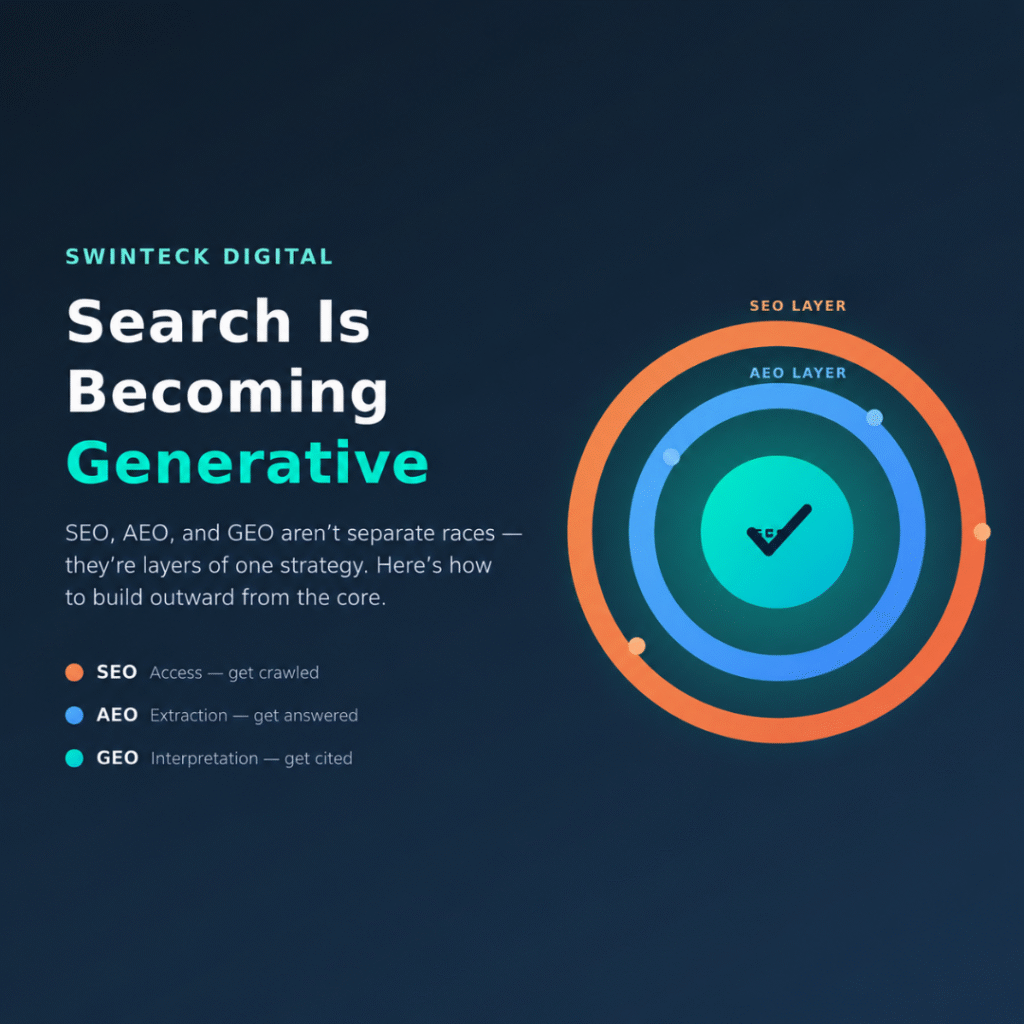
Swinteck’s take: SEO handles access (getting crawled), AEO handles extraction (getting direct answers), and GEO handles interpretation (getting AI to understand and recommend you). They aren’t rivals — they’re layers of one modern strategy.
2. Why Is This Shift Happening?
The driver is user behavior. Traditional search requires people to click multiple links, read long pages, and synthesize an answer themselves. Generative engines do that synthesis instantly.
Industry reporting through 2025–2026 points to a growing share of queries now surfacing an AI-generated overview before a single organic “blue link” appears, and a rising number of high-intent buyers researching products entirely inside conversational tools like ChatGPT or Perplexity. If your content only targets classic SEO keywords, you’re leaving a growing share of AI-driven search on the table.
3. How to Optimize for GEO: The 2026 Blueprint
Shifting from SEO to GEO doesn’t mean rebuilding your website from scratch — it means adapting your content so AI engines want to cite you.
- Prioritize Information Gain over rehashed content: AI models are trained to filter out redundancy. If your posts simply repeat what every competitor says, AI crawlers will skip them. Bring unique data, case studies, or proprietary methodology to earn a citation.
- Build topic clusters, not just keyword pages: Create hub-and-spoke content — a central hub (e.g., “Local SEO”) linked to focused sub-pages on niche angles like Google Maps citation factors or local schema markup. AI engines reward topical depth.
- Lead with succinct, citable answers: Skip 1,000 words of preamble. Open with a direct, high-value assertion, then support it with short, clear sentences AI engines can lift into a summary.
- Cultivate brand mentions across the web: AI engines weigh how often your brand is mentioned in association with your industry, not just backlink counts. Guest posts, digital PR, podcast features, and active forum participation (e.g., Reddit) build the E-E-A-T signals LLMs look for.
Your Growth. Our Strategy.
The shift to GEO can feel like a lot to take on — but it’s also the single biggest opportunity for forward-thinking business owners to outpace competitors who are still playing yesterday’s SEO game.
At Swinteck, we build future-proof digital marketing frameworks that combine SEO’s technical fundamentals with modern GEO and AEO strategy — so your brand isn’t just indexed, but visible, cited, and recommended by the AI tools your customers use every day.
Ready to grow faster and stress less? Let’s talk strategy.
Website: swinteck.com
Phone / WhatsApp: +91-7973934868
Email: swinteckdigital@gmail.com
Frequently Asked Questions
Q1. What is the main difference between SEO and GEO?
Traditional SEO focuses on ranking your website on the first page of search results (like Google) through keywords and backlinks. GEO is the process of optimizing your brand’s content so AI engines — ChatGPT, Gemini, Perplexity — understand your business and cite you as a trusted source in their generated answers.
Q2. Will GEO completely replace traditional SEO in 2026?
No — GEO is an evolution, not a replacement. Foundational SEO practices like fast load speed, mobile-friendliness, secure hosting, and clean technical structure remain the base layer. GEO builds on top by ensuring your content is written and structured so AI models can easily read, trust, and recommend it.
Q3. How can my business start optimizing for GEO today?
- Create unique content: Write articles with original insights, data, or expert opinion rather than rehashed information.
- Write conversational answers: Structure content to answer direct questions clearly and succinctly, right at the top of the page.
- Build off-page trust (E-E-A-T): Get your brand mentioned on authoritative platforms, forums, and local directories so AI models recognize your authority.
Q4. Why is “Information Gain” important for modern search optimization?
AI search engines are trained to filter out duplicate or repetitive content. Information Gain refers to the unique, additional value your content brings to a topic. Original case studies, client testimonials, or industry insight make it far more likely that AI engines will pull and cite your page.
Q5. How does Swinteck help businesses transition from SEO to GEO?
We optimize your website’s technical foundation, restructure your content to match conversational search patterns, and build strong online authority — so your brand is discovered and recommended by both traditional search engines and modern generative AI tools.